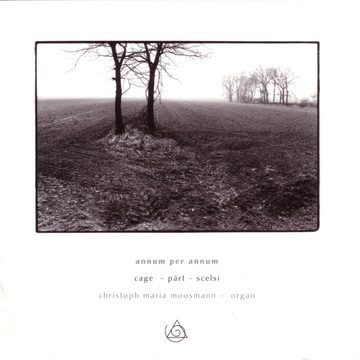
 Christop Maria Moosmann
organ works of Arvo Pärt, Giacinto Scelsi, and John Cage. Recorded in the Cathedral of Rottenburg, Germany. Moosmann's sensitive and articulate performances reveal just how expansive, how impressionistic, how exquisite the instrument can be. A gorgeous introduction to modern organ repertoire. * * * * --Classic CD None of these three composers are or were organists, yet here is some of the most compelling contemporary organ music. Perhaps it is the intense religiosity of Pärt and the cooler spiritualism of Scelsi or Cage (both of whom were devotees of Zen Buddhism) that make their organ excursions so valid, because the organ is, finally, the instrument of the divine. All three have found ways to breathe life into the "monster which never breathes" (Stravinsky). Perhaps the breaths it takes are simply very long and deep. All of Pärt's organ output is heard here. Compared to his repertory of choral and vocal sacred music, this is a small canon, but it is good to know it, especially in the light of his longer works such as "Passio" and "Tabula Rasa". Many of his principles of composition - the directness, the studied simplicity, what he calls "tintinnabuli" - are found in these works. By Cagean standards, "Souvenir" is a relatively mild piece; for the most part it wanders freely along reiterating rather neutral melodic fragments and harmonic clusters with occasional rude outcroppings from the organ's lower and louder extremities. Like much of Cage's music, it is meant to be about that moment in time, and nothing more nor anything less. Giacinto Scelsi has been called the Charles Ives *and* John Cage of Italy - the former because of his independence and removal from mainstream musical institutions, the latter because of an unceasing experimentalism. But he is really neither - he is only the Scelsi of Italy, "l'unico". "In nomine lucis" seems to be about the very foundations of the organ itself. It sits and rumbles mysteriously until it finally erupts near the end, where the listener is literally blown away. The beating tones caused by microtonal differences in the mechanical registrations of the organ have a rhythmic life of their own and give the music an otherwordly quality. Sublime compositions finely recorded and performed -- the urge to explore must be strong with an instrument you physically occupy. --The Wire Available here: iTunes HDtracks 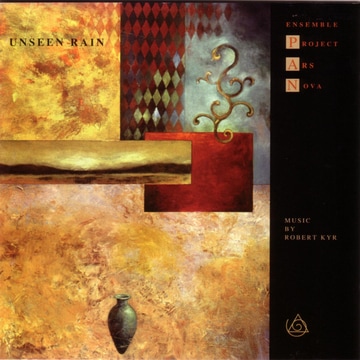 Unseen Rain
Ensemble PAN. Texts by Guillaume de Machaut, Jean Joubert, Arthur Rimbaud, Hildgard von Bingen, Leon Felipe, Jorge Luis Borges, Mirza Ghalib, Niu His Chi, Kalidasa, Guillaume Apollinaire, Leopardi and Rumi. vocal music by Robert Kyr, performed by Ensemble PAN with the Back Bay Chorale: texts by Guillaume de Machaut, Jean Joubert, Artur Rimbaud, Hildegard von Bingen, Leo Felipe, Jorge Luis Borges, Mirza Ghalib, Niu Hsi Chi, Kalidasa, Rumi a.o. A fascinating album consisting of new music steeped in the technique and aesthetics of music 600 years old. --The Atlantic Monthly "Unseen Rain" was commissioned by the Chase Foundation in celebration of the 75th Anniversary of the Longy School of Music (Cambridge, Massachusetts). Even before choosing the texts, I decided to compose a work for many more singers than instrumentalists, which would include as many members of the Longy community as possible. I wanted the vocalists to dominate the attention of the listeners and to be the dramatic focus of the work. The Chase Foundation also specified that the texts were to be "in celebration of music" and must not be too somber or grim in general tone. Early in my search, it became clear that the twentieth century would probably not yield poetic texts of this nature. I wanted to find epigrammatic, haiku-like texts which were filled with simple words and direct images. Fortunately, I found some beautiful translations of Rumi's quatrains (short poems of four lines each) and after reading at least 500 of them, I set about the task of creating a celebratory musical drama from the general collection. The work fell into three parts: in the first, "The Prophet's Quatrains," the countertenor is a prophet beseeching the community (the chorus) to remain awake throughout the night in order to fully experience the joys of music; in the second, "The Lovers' Quatrains," the soprano and tenor are lovers rejoicing in the similarities between love and music; and in the third, "A Communal Affirmation," the prophet and the lovers join the chorus to proclaim the spiritual power of music ("Listen to the unstruck sounds, and what sifts through that music..."). The title of the work is an image taken from one of Rumi's quatrains - it relates to the end of the piece, when what has been hidden (unseen/unheard) finally becomes apparent. The Persian word for "Unseen Rain" also refers to "grace". --Robert Kyr Available here: iTunes HDtracks 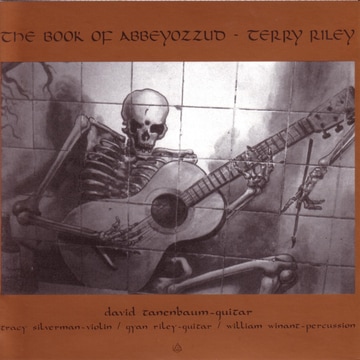 The Book of Abbeyozzud
Works for Guitar, plus accompaniment David Tanenbaum, guitar; with Gyan Riley, guitar; Tracy Silverman, violin; William Winant, percussion Guitar? We think of Riley as a keyboard man just as we think of Glass and many another minimalists. Reading the composer's notes, though, the impression is that these pieces are more in fealty to the traditions of Spanish music than the guitar per se. Either way, the music sounds much as you would anticipate: American chamber with Jelly Roll Morton's beloved 'Spanish tinge', the Eastern modes which Riley sets his stars by, and that unique pragmatism which [Glenn] Gould suggested was manifest as music which 'requires instructions rather than instruction'. --The Wire, October 1999 The Book of Abbeyozzud (say "ah-BYE-ah-ZOOD", a word invented by Riley, without meaning) is a planned series of 26 pieces for guitar, multiple guitars and guitar in ensemble. So far, thirteen pieces are completed. Riley writes "All of the pieces have Spanish titles and take a different letter of the alphabet to begin their names. They are also indebted to great Spanish music traditions and to those traditions upon which Spanish music owes its heritage." David Tanenbaum had been asking Terry Riley for a guitar piece for some time, and found success finally after Terry's young son, Gyan, began studying classical guitar and brought its world into the Riley home. David Tanenbaum commissioned the first piece, "Ascención," through Albert Augustine Ltd., and through the editing and performance process of that piece the idea for the book was born. Some of Riley's most melodious compositions yet and his first written for the guitar ... make for one of Riley's most approachable albums; in particular, the mellifluous 'Cantos Desiertos' should be a public radio staple. --Billboard, November 20, 1999 Available here: iTunes |